
Why Protein Requirements Are Often Misunderstood
Ask ten different people how much protein you really need, and you’ll get ten different answers.
Some say eat as much as possible. Others warn against too much. Most advice lands somewhere in the middle — but without a clear reason why.
The truth is, protein needs are not one-size-fits-all. They depend on your body weight, your goals, your activity level, and whether you’re trying to lose fat, build muscle, or simply maintain what you have.
Understanding how much protein do you need starts with understanding what protein actually does inside your body — and why getting it wrong has real consequences for your muscle, your metabolism, and your energy.
This guide is part of the Fueled Framework protein strategy for metabolic health, which focuses on protecting muscle while supporting fat loss. “Most nutrition guidelines recommend around 0.36 grams of protein per pound of body weight, which aligns with the recommended daily protein intake guidelines published by the National Institutes of Health.”
Why Protein Matters for Muscle and Metabolism
Protein is not just a macronutrient. It is the structural foundation of your lean tissue.
Every time you move, your muscles are being used and slightly broken down. Protein is what your body uses to repair and rebuild that tissue. Without enough of it, you don’t just fail tco build muscle — you can actually lose it.
This matters even if you’re not trying to build muscle. Muscle is metabolically active tissue. It burns calories at rest. It supports insulin sensitivity. It keeps your metabolism running efficiently as you age.
Protecting your muscle means protecting your metabolism. The two are inseparable.
Protein also plays a direct role in satiety — the feeling of fullness. A diet adequate in protein helps regulate hunger hormones, which makes it easier to eat less without feeling deprived.
For anyone focused on fat loss, metabolic health, or body composition, protein is not optional. It is foundational.
General Daily Protein Requirements
Most nutrition organizations set the minimum protein requirement at around 0.36 grams per pound of body weight per day. This is the amount needed to prevent deficiency in sedentary adults.
For most people with active lives, body composition goals, or any degree of metabolic concern, this number is far too low.
Research consistently supports higher protein intake for anyone who:
- Is physically active
- Is in a calorie deficit for fat loss
- Is over 40 and concerned about muscle preservation
- Is managing blood sugar or metabolic health
- Is working to build or maintain lean mass
For these populations, the evidence-based range for daily protein requirements falls between 0.7 and 1.0 grams per pound of body weight. Some individuals pushing hard in resistance training can benefit from going slightly higher, up to 1.2 grams per pound.
The Fueled Framework approach targets this research-supported range: enough protein to protect muscle, support metabolism, and make body composition goals achievable without extremes.
If you want a quick estimate based on your body weight and activity level, you can use our Protein Intake Calculator.
Simple Per-Pound Body Weight Formula
The easiest way to calculate your personal protein target is the per-pound body weight method.
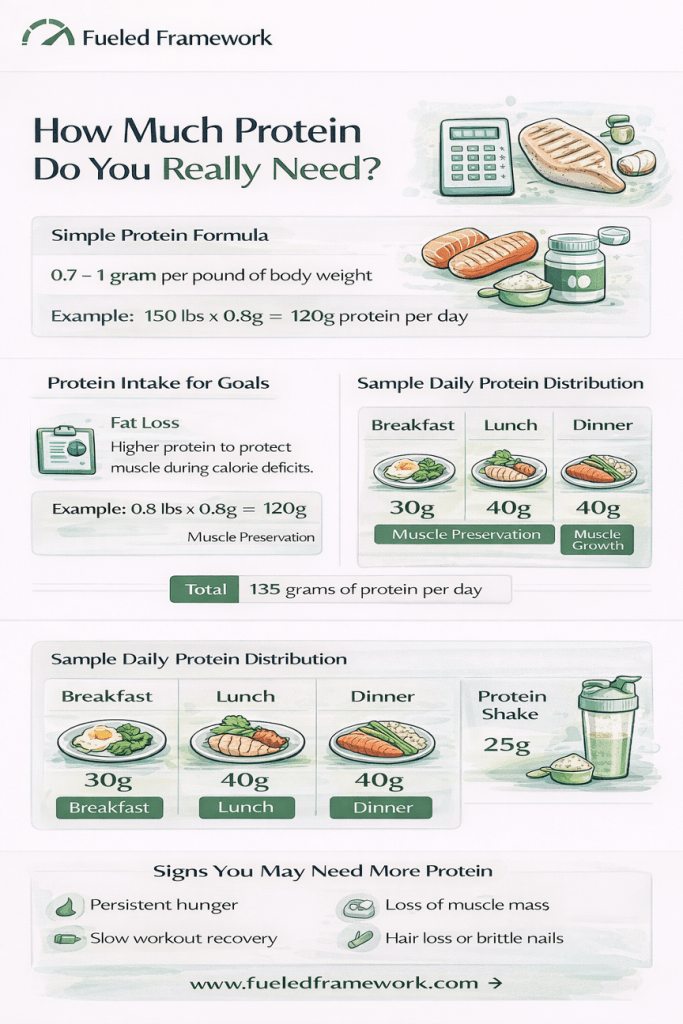
Target: 0.7 to 1.0 grams of protein per pound of body weight per day
For most people in a fat loss phase, 0.8 to 1.0 grams per pound is a practical starting point. For muscle building or maintenance phases, the same range applies.
If you have significant weight to lose, it’s common practice to use your goal body weight — or a moderate estimate of your lean mass — rather than your current weight. This prevents over-calculating protein needs in cases of high body fat.
How to Use This Formula
Step 1: Write down your current body weight in pounds.
Step 2: Multiply by 0.8 as a starting target.
Step 3: Adjust up to 1.0 if you are very active, in a significant calorie deficit, or prioritizing muscle building.
Step 4: Divide your daily total across meals to hit your number consistently.
Example Calculations for Different Body Weights
These examples use the 0.8 to 1.0 gram range for a practical daily target.
Example 1: 150-Pound Person
At 0.8g/lb: 120 grams of protein per day
At 1.0g/lb: 150 grams of protein per day
A reasonable daily target for this person would be 120–150 grams spread across three to four meals.
Example 2: 180-Pound Person
At 0.8g/lb: 144 grams of protein per day
At 1.0g/lb: 180 grams of protein per day
A daily target of 144–180 grams is appropriate, depending on activity level and whether the goal is fat loss, maintenance, or muscle building.
Example 3: 220-Pound Person
At 0.8g/lb: 176 grams of protein per day
At 1.0g/lb: 220 grams of protein per day
For this individual, a range of 175–200 grams per day is a strong working target. If body fat is high, working toward a goal weight of 180–190 lbs may be a more practical basis for the calculation.
These numbers are starting points, not rigid rules. Consistency over time matters more than hitting an exact number every single day.
To make this easier to apply, here is a visual breakdown of protein calculation and daily distribution.
Most nutrition guidelines recommend around 0.36 grams of protein per pound of body weight, which represents the minimum intake required to avoid deficiency. You can see the full breakdown of how much protein you need per day in research summarized by Harvard Health.
How Much Protein You Really Need During Fat Loss
Protein intake for weight loss is one of the most important — and most overlooked — factors in a fat loss plan.
When you’re in a calorie deficit, your body needs more dietary protein, not less. Here’s why: when calories are restricted, the body looks for energy wherever it can find it. Without enough protein in the diet, it will break down muscle tissue to meet its needs.
This is called muscle catabolism, and it works directly against your goals. Losing muscle while losing fat slows your metabolism, changes your body composition in the wrong direction, and makes it harder to maintain any progress you make.
Higher protein intake during fat loss:
- Protects lean muscle tissue
- Keeps hunger more manageable
- Supports better metabolic outcomes
- Preserves strength and physical function
During a fat loss phase, aim for the higher end of your protein range — closer to 1.0 gram per pound of body weight. This is a non-negotiable component of a well-structured nutrition plan.
If you’re working with appetite-reducing medications, this principle is even more critical. Reduced appetite can lead to unintentionally low protein intake, which puts muscle at significant risk.
Related reading:
→ How to Prevent Muscle Loss on GLP-1 Medications
→ How Much Protein Should You Eat on GLP-1?
Protein Needs During Muscle Building
Building muscle requires two things: a stimulus (resistance training) and adequate nutrition to support recovery and growth. Protein is the core nutritional driver of that process.
To understand how much protein to build muscle, the research points to the same general range: 0.7 to 1.0 grams per pound of body weight, with some highly active individuals benefiting from up to 1.2 grams per pound.
More protein beyond 1.2 grams per pound does not appear to offer additional muscle-building benefit for most people. At a certain point, the excess is simply used for energy or excreted.
Key Points for Muscle Building
- Stay within the 0.8–1.0 gram per pound range as your primary target
- Prioritize protein quality — complete protein sources with all essential amino acids
- Distribute protein evenly across meals to maximize muscle protein synthesis throughout the day
- Don’t neglect overall calorie intake — you need sufficient energy to build
Consistency is what drives muscle building. Hitting your protein target most days, week after week, produces far better results than sporadic high-protein days surrounded by low-protein days.
How to Distribute Protein Across the Day
Total daily protein matters. But how you distribute it across meals also plays a role in how effectively your body uses it.
Research suggests that muscle protein synthesis — the process by which your body builds and repairs muscle — is optimized when protein is spread relatively evenly across meals, rather than concentrated in one sitting.
A practical approach is to aim for 25 to 50 grams of protein per meal, across three to four meals per day. This range is enough to trigger a meaningful muscle protein synthesis response without exceeding what the body can optimally use in a single sitting.
Example Daily Distribution — 150g Target
Breakfast: 35g protein — eggs, Greek yogurt, cottage cheese
Lunch: 40g protein — grilled chicken, lentils, or lean beef
Dinner: 45g protein — salmon, turkey, or another lean protein source
Snack: 30g protein — protein shake or high-protein snack if needed
You don’t need to be perfect every meal. Aim for a protein anchor at every eating occasion and let the total add up across the day.
Breakfast Protein Matters
Starting the day with at least 25–35 grams of protein is one of the most effective habits for managing hunger throughout the day, stabilizing energy, and supporting muscle maintenance.
Many people under-eat protein at breakfast and over-compensate at dinner. Spreading intake more evenly tends to produce better results for both body composition and energy stability.
Signs Your Protein Intake May Be Too Low
Protein deficiency is rare in the developed world at extreme levels. But chronically low protein intake — enough to impair muscle maintenance and metabolic function — is common.
If you’re consistently under-eating protein, you may notice:
- Persistent hunger even after meals
- Difficulty maintaining strength during training
- Slow recovery from workouts or physical activity
- Difficulty maintaining or building lean muscle
- Increased sugar and carbohydrate cravings
- Fatigue that doesn’t resolve with adequate sleep
These signs don’t always point to protein as the cause. But if you’re experiencing several of them and your daily protein intake is consistently below 0.6 grams per pound of body weight, increasing protein is a reasonable first step.
Track your intake for a week using any basic food logging app. Many people are surprised to find they’re eating significantly less protein than they think — especially if their diet is heavy in processed foods, refined carbohydrates, or plant-based options without intentional protein pairing.
Summary: Protein Is Foundational for Metabolic Health
Understanding how much protein do you need is not about chasing an extreme number. It’s about giving your body what it needs to function well, maintain lean tissue, and support your health goals over time.
The core framework is simple. Aim for 0.7 to 1.0 grams of protein per pound of body weight per day. Use the higher end during fat loss phases. Distribute intake evenly across three to four meals. Prioritize high-quality, complete protein sources.
Protein is not a trend. It is a fundamental building block of muscle, metabolism, and long-term health. The Fueled Framework is built around this principle — structured nutrition that protects what matters and supports sustainable results.
Consistent protein intake, distributed across the day, is one of the highest-leverage nutrition habits you can build.
Whether your goal is fat loss, muscle maintenance, or simply better metabolic health, protein is the variable most worth getting right.
Explore more from Fueled Framework: