
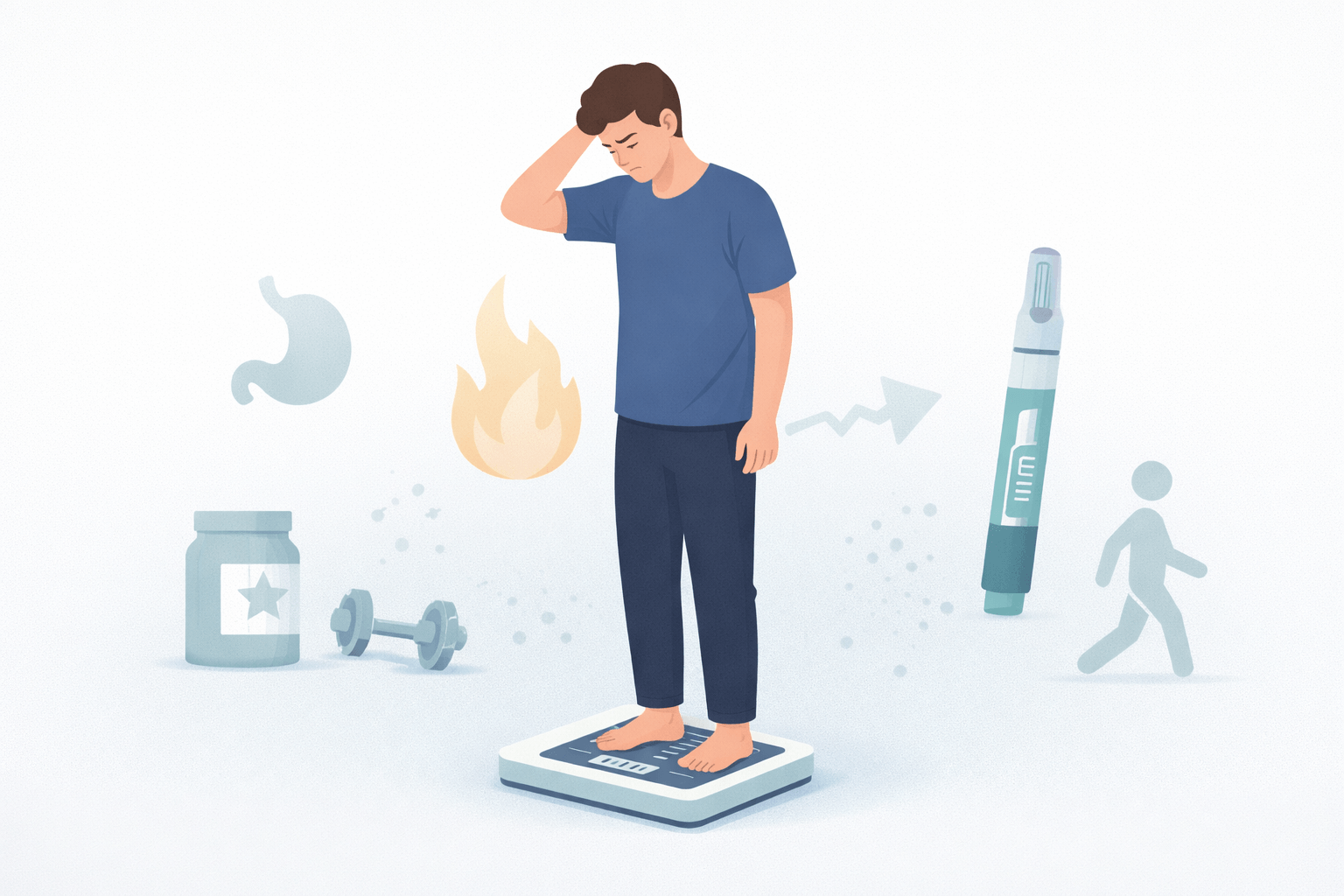
You were losing weight. The appetite suppression was working. You felt in control. Then, somewhere around month three or four, the scale stopped moving. You started asking yourself: did Ozempic stop working?
It feels like a betrayal. You changed your life, followed the plan, and now the results have vanished. The frustration is real — and completely understandable.
But here is the thing: Ozempic did not stop working. Your body did exactly what it is designed to do.
| The Direct Answer Ozempic appears to stop working because your body undergoes metabolic adaptation — a biological response to sustained calorie restriction and weight loss. As you lose weight, your basal metabolic rate (BMR) drops, your body burns fewer calories at rest, and your appetite signals adjust. The medication is still suppressing appetite and regulating blood sugar as designed. The plateau is a metabolic event, not a medication failure. |
Why Has My Weight Loss Stopped?
Answer 5 quick questions to identify what’s causing your GLP-1 plateau.
Are you eating enough protein each day?
Target is 1.2–1.6g per kilogram of body weight. For an 80kg person, that means 96–128g daily.
Low protein can lead to muscle loss, which reduces your resting metabolic rate and makes continued weight loss harder — even with GLP-1 medication.
Has your daily calorie intake dropped very low?
Eating below 900–1,000 kcal consistently can trigger metabolic downregulation — your body burns less to compensate.
Your metabolism may have adapted and slowed down. A controlled calorie increase — focused on protein — can restore metabolic rate and restart fat loss.
Has your daily movement decreased since starting treatment?
Non-exercise movement (NEAT) — steps, standing, fidgeting — can drop by 200–300 calories per day during calorie restriction without you noticing.
Lower activity reduces total daily calorie burn. Even small increases in movement — a daily 20-minute walk, taking stairs — can meaningfully close the gap.
Are you experiencing constipation or slow digestion?
GLP-1 medications slow gastric emptying. Chronic constipation can add 1–3kg to the scale and impair nutrient absorption.
Digestive slowdown can cause bloating and mask real fat loss on the scale. Increasing fibre to 25–35g/day, hydration, and gentle movement all support gut motility.
Are you expecting steady weekly weight loss every week?
Weight loss is rarely linear. Hormonal fluctuations, water retention, and muscle gain can all stall the scale — even when fat loss is continuing.
Plateaus are normal and expected — your body adapts over time. Track measurements and energy levels alongside the scale for a complete picture of progress.
Next step: Adjust your nutrition, protein intake, and activity levels using the Fueled Framework GLP-1 Nutrition System.
| What Is a GLP-1 Weight Loss Plateau? A GLP-1 weight loss plateau is a period during semaglutide or tirzepatide treatment when weight loss slows significantly or stops entirely, despite continued medication use. It typically occurs because the body has adapted to a lower calorie intake, reduced its metabolic rate, and recalibrated hunger hormones — not because the drug has become ineffective. |
Why Did Ozempic Stop Working?
The question everyone asks — and the answer most people never get. Let's walk through the biology clearly.
Ozempic (semaglutide) works by mimicking GLP-1, a hormone that signals fullness, slows gastric emptying, and stabilises blood sugar. It is remarkably effective at reducing calorie intake, especially in the early months of treatment.
The problem is not the drug. The problem is that sustained weight loss triggers a predictable set of compensatory mechanisms in the human body. These mechanisms evolved to protect you from starvation. They do not distinguish between intentional dieting and genuine food scarcity.
The Real Reason: Metabolic Adaptation
| What Is Metabolic Adaptation? Metabolic adaptation (also called adaptive thermogenesis) is the process by which your body reduces its total energy expenditure in response to weight loss and reduced calorie intake. It is a survival mechanism that makes continued weight loss progressively harder over time. |
When you lose a meaningful amount of weight, several things happen simultaneously:
- Your body is physically smaller, so it requires fewer calories to function
- Your resting metabolic rate drops beyond what the weight loss alone would predict
- Your hunger hormones (ghrelin) increase, pushing appetite upward
- Your non-exercise movement naturally decreases as your body conserves energy
Research published by the National Institutes of Health has shown that metabolic adaptation can account for a 10–15% reduction in total daily energy expenditure beyond what weight loss alone would cause. This is not a small number. For many people, it represents 200–300 fewer calories burned per day.
For a full explanation, see our guide on What Is Metabolic Adaptation.
How Basal Metabolic Rate Changes During GLP-1 Treatment
| What Is Basal Metabolic Rate (BMR)? Basal metabolic rate is the number of calories your body burns at complete rest to maintain essential functions — breathing, circulation, organ function, and temperature regulation. It accounts for roughly 60–70% of total daily energy expenditure. |
As you lose weight on Ozempic, your BMR drops in proportion to your new, smaller body. A person who started treatment at 100kg and has lost 15kg now has a meaningfully smaller metabolic engine. They need fewer calories not because something went wrong — but because they are carrying less mass.
The issue is that many people continue eating the same reduced amount that produced weight loss earlier in treatment. Their calorie intake has not changed. Their calorie burn has. That gap closes, and weight loss stalls.
Use our Protein Intake Calculator to recalibrate your intake based on your current weight.
Adaptive Thermogenesis Explained Simply
Beyond the straightforward BMR reduction, your body also deploys a second, more subtle mechanism: adaptive thermogenesis.
| Adaptive Thermogenesis Adaptive thermogenesis refers to the additional reduction in calorie burn that occurs during and after calorie restriction — beyond what would be predicted by changes in body weight alone. It reflects the body actively conserving energy in response to a perceived food shortage. |
In practical terms, this means your body becomes more efficient. It does more with less. The same movement that used to burn 200 calories may now burn 160. This adaptation is not a sign of failure. It is your metabolism working exactly as it evolved to work.
Harvard Health Publishing describes this as one of the primary reasons long-term weight maintenance is harder than initial weight loss. The body's compensatory response is persistent and measurable for years after significant weight loss.
| ⚠️ It Didn't Stop Working — Your Body Adapted The single most common misunderstanding about Ozempic plateaus is framing them as medication failure. They are not. Ozempic is still doing its job — suppressing appetite, slowing gastric emptying, stabilising insulin response. What has changed is the metabolic environment that the medication is operating in. Your body has adapted. That adaptation requires a response — not a resignation. The fix is not a higher dose (in most cases). The fix is a smarter nutrition strategy. |
Why Does Weight Loss Plateau on GLP-1? Six Contributing Factors
1. You May Be Eating Too Little
This sounds counterintuitive. How can eating less cause a plateau? The answer is metabolic downregulation.
Ozempic is highly effective at suppressing appetite. Some people find their intake drops to 800–900 calories per day without intending it. At that level, the body treats the deficit as a survival threat and aggressively reduces energy expenditure to compensate.
The result is a plateau — and often muscle loss, fatigue, and nutritional deficiencies alongside it.
Learn to recognise the warning signs in: Signs You're Not Eating Enough on GLP-1.
2. Muscle Loss Is Reducing Your Metabolic Rate
| Why Muscle Mass Matters for Weight Loss Muscle tissue is metabolically active — it burns more calories at rest than fat tissue does. When you lose muscle mass, your resting metabolic rate drops, making further weight loss progressively harder. |
GLP-1 medications reduce overall food intake. Without deliberate effort to maintain protein intake and resistance training, a significant portion of weight lost on Ozempic can come from muscle, not fat.
Studies on GLP-1 medications have raised concerns that lean mass loss may account for 25–40% of total weight lost in some individuals — particularly those who are not following a structured nutrition plan.
The downstream effect: less muscle means a lower BMR, which makes breaking the plateau even harder.
See: How to Prevent Muscle Loss on GLP-1 for a complete protocol.
3. Reduced Daily Movement (NEAT) Is Cutting Your Calorie Burn
| What Is NEAT? Non-Exercise Activity Thermogenesis (NEAT) is the energy burned through all movement that is not formal exercise — walking, fidgeting, standing, household tasks. NEAT can account for 200–600 calories per day and drops significantly during calorie restriction. |
When your body is in an energy-conserving state, it subtly reduces your spontaneous movement. You fidget less. You sit more. You take fewer steps without realising it.
Research tracking patients during weight loss programmes has shown NEAT reductions of up to 300 calories per day — a significant and often overlooked contributor to a weight loss plateau.
4. Water Retention May Be Masking Fat Loss
The scale measures total body mass — not just fat. Water retention can temporarily mask ongoing fat loss, creating the illusion of a plateau when fat loss is actually continuing.
Common causes of water retention during GLP-1 treatment include:
- Increased sodium intake
- Hormonal fluctuations (particularly in women)
- Inflammation from increased physical activity
- Glycogen replenishment after a period of very low carbohydrate intake
- Inadequate hydration, paradoxically causing the body to retain water
If the scale is stalled but your clothes are fitting differently, fat loss may still be occurring. Tracking body measurements alongside weight gives a more accurate picture.
5. Digestive Slowdown Is Affecting More Than You Think
| ⚠️ Why Digestion and Constipation Can Affect Weight Loss One of Ozempic's core mechanisms is gastric emptying delay — food moves through your digestive system more slowly. This is what reduces appetite and stabilises blood sugar. But it also contributes to constipation, bloating, and gastrointestinal discomfort. When constipation becomes chronic, the cumulative weight of undigested material can add 1–3kg to the scale reading. More importantly, poor gut function affects nutrient absorption, energy levels, and the hormonal signals that govern appetite and metabolism. Addressing digestive health is not a secondary concern on GLP-1 treatment — it is central to metabolic function. See: GLP-1 Constipation for a structured approach. |
Why Plateaus Are Normal — and Expected
A weight loss plateau is not an anomaly. It is a predictable, biologically programmed stage of any sustained weight loss effort.
The Cleveland Clinic notes that almost everyone who loses weight will experience at least one plateau — often multiple — during the process. The timing, duration, and intensity vary, but the mechanism is universal.
Understanding this reframes the experience. A plateau is not a sign that you have failed or that the medication is failing. It is a signal that your body has recalibrated and your strategy needs to evolve with it.
| Key Insight The first phase of GLP-1 treatment leverages powerful appetite suppression. The second phase — the one most people are not prepared for — requires an active nutrition strategy to overcome metabolic adaptation. That is where the Fueled Framework system is designed to operate. |
How to Break a GLP-1 Weight Loss Plateau
Breaking a metabolic plateau requires working with your body's adaptation — not against it. These strategies are evidence-informed and designed specifically for people using GLP-1 medications.
Step 1: Audit Your Protein Intake
Protein is the most important nutritional lever available to you during a GLP-1 plateau. It:
- Preserves muscle mass, protecting your BMR
- Has the highest thermic effect of any macronutrient — roughly 25–30% of protein calories are burned during digestion
- Increases satiety independently of GLP-1 action
- Supports tissue repair and metabolic health
Target range: 1.2–1.6g of protein per kilogram of body weight per day. For someone at 80kg, that means 96–128g of protein daily — a target many GLP-1 users are not meeting because suppressed appetite reduces overall food intake.
Use the Protein Intake Calculator to find your precise target.
Step 2: Recalculate and Slightly Raise Your Calories
If you have been eating below 1,000–1,100 calories per day for an extended period, a controlled calorie increase (often called a diet break or reverse diet) can restore metabolic rate and break the adaptive response.
This is counterintuitive but well-supported. Eating slightly more — with an emphasis on protein — can reignite fat loss by signalling to your body that food is available and metabolic downregulation is no longer necessary.
See the GLP-1 Meal Plan for structured daily eating guidance.
Step 3: Add or Prioritise Resistance Training
Cardio burns calories in the short term. Resistance training rebuilds and maintains the muscle mass that protects your metabolic rate long-term.
Even two sessions per week of progressive resistance training — bodyweight exercises, resistance bands, or free weights — can meaningfully slow muscle loss and support continued fat loss during a GLP-1 plateau.
Step 4: Optimise Hydration
Dehydration impairs every metabolic process. During GLP-1 treatment, reduced food intake also means reduced water from food sources. Most people need to be deliberate about fluid intake.
Target: 35ml per kilogram of body weight per day. For an 80kg person, that is approximately 2.8 litres. Start there and adjust based on activity level, climate, and individual variation.
Step 5: Prioritise Sleep and Manage Stress
Sleep deprivation elevates cortisol, increases ghrelin (the hunger hormone), and directly impairs glucose regulation and fat burning. Poor sleep alone can stall weight loss even in the presence of a calorie deficit.
Research published in the journal Obesity has shown that sleep-deprived individuals lose significantly less fat and more lean mass compared to well-rested subjects in identical calorie-deficit conditions.
Step 6: Address Digestive Health Directly
If constipation, bloating, or gastric discomfort are present, address them as a priority — not an afterthought. Adequate fibre intake (25–35g per day), consistent hydration, and gentle movement all support gut motility and reduce the scale-masking effects of constipation.
Full guidance: GLP-1 Constipation.
Quick Plateau Fix Checklist
Use this checklist to identify and address the most common causes of a GLP-1 weight loss plateau:
- ☐ Am I eating at least 1.2g of protein per kg of body weight?
- ☐ Am I eating enough total calories? (Aim for at minimum 1,000–1,200 kcal/day)
- ☐ Have I recalculated my calorie needs based on my current weight?
- ☐ Am I doing at least 2 resistance training sessions per week?
- ☐ Am I drinking 35ml of water per kg of body weight per day?
- ☐ Am I getting 7–9 hours of quality sleep per night?
- ☐ Is constipation or bloating affecting my scale readings?
- ☐ Am I tracking body measurements, not just the scale?
- ☐ Am I eating adequate dietary fibre (25–35g per day)?
- ☐ Have I spoken with my prescribing clinician about my current progress?
Frequently Asked Questions
Why am I not losing weight on Ozempic anymore?
The most likely reasons are metabolic adaptation (your body has reduced its calorie burn in response to weight loss), inadequate protein intake leading to muscle loss, or a calorie intake that is too low — triggering a survival response that suppresses your metabolism. Start with a protein audit and recalculate your current calorie needs.
Does Ozempic stop working after a few months?
No. Ozempic continues to act on GLP-1 receptors, suppressing appetite and regulating blood sugar, for as long as it is taken. What changes is the metabolic context it is operating in. Your body adapts, and your nutrition strategy needs to evolve in response.
How long does an Ozempic plateau last?
Without any strategic changes, a plateau can persist indefinitely. With active intervention — protein optimisation, calorie recalibration, resistance training, and digestive support — most people see renewed progress within 3–6 weeks.
Does the same plateau happen with Wegovy and Mounjaro?
Yes. The metabolic adaptation response is universal and occurs with all GLP-1 and GLP-1/GIP medications, including Wegovy (semaglutide) and Mounjaro (tirzepatide). The mechanisms are identical. The solutions are identical.
Should I increase my Ozempic dose if weight loss has stalled?
Dose adjustments should only be made under the guidance of your prescribing clinician. In many cases, a plateau does not require a higher dose — it requires a stronger nutrition strategy. Discuss both options with your healthcare provider before making any changes.
Why did I lose weight faster in the beginning?
Early GLP-1 weight loss is often rapid because the appetite suppression is most pronounced initially, and the body has not yet triggered its full adaptive response. Over time, the body compensates, and that early rate of loss naturally slows. This is expected and does not mean the medication is becoming less effective.
The Bottom Line
A weight loss plateau on Ozempic is not the end of the road. It is a biological checkpoint — a signal that your body has adapted and that your strategy needs to evolve alongside it.
The medication is working. Your metabolism has simply recalibrated. The path forward is not a higher dose or a different drug. It is a structured nutrition system built specifically for the biology of GLP-1 treatment.
That means protecting muscle mass with adequate protein, recalibrating your calories to your current weight, supporting gut health and hydration, and building the movement habits that sustain a healthier metabolic rate long term.
Everything you need to implement that system is inside the GLP-1 Nutrition Guide — the central resource for every Fueled Framework nutrition strategy. It is the place to start, and the place to return to every time your body signals that the approach needs to evolve.