
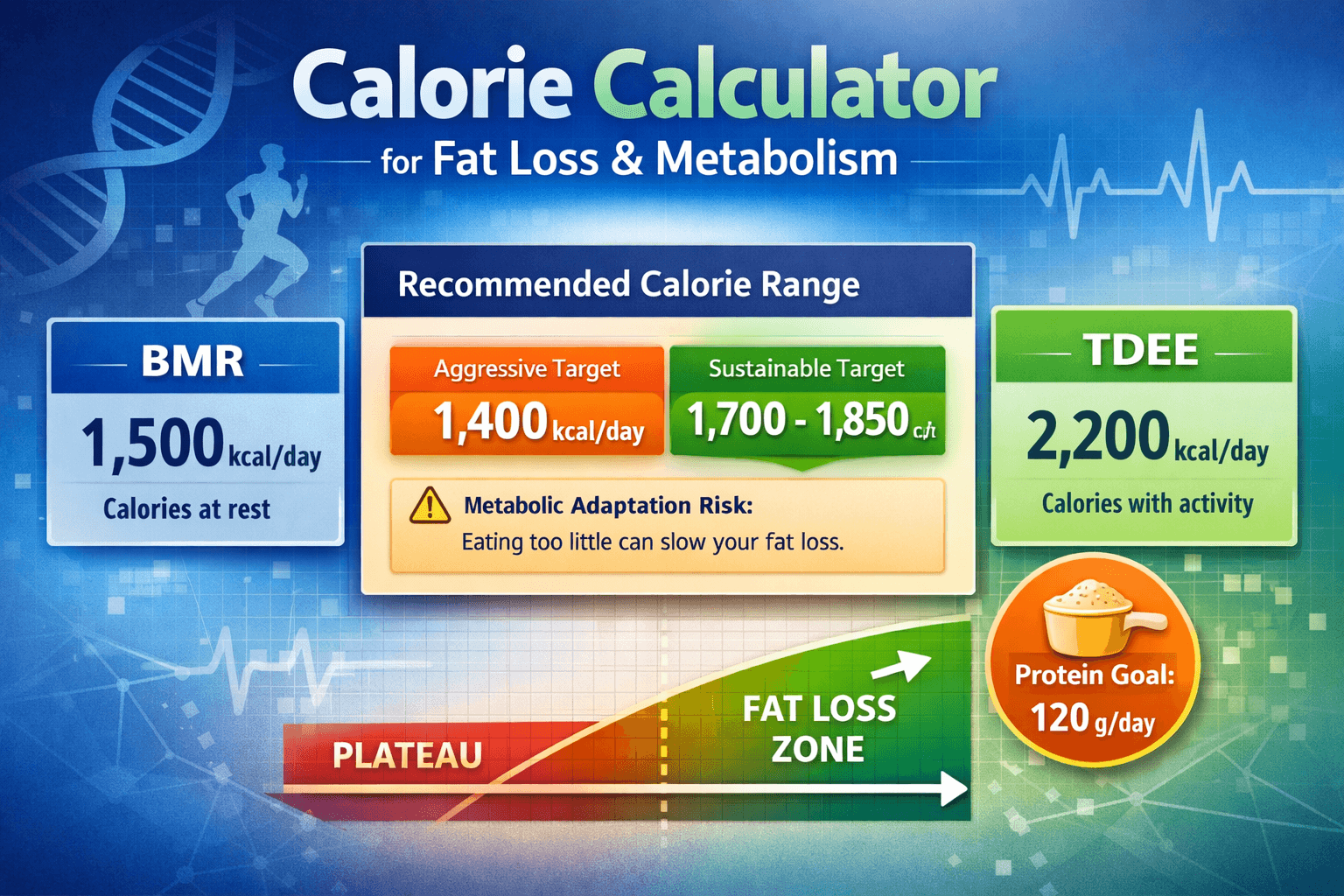
Most calorie calculators give you a number. This one checks whether that number is actually safe for your metabolism — and adjusts it if it is not.
| What is a calorie calculator? A calorie calculator estimates how many calories your body needs daily based on your metabolism, activity level, and goals. This tool also applies a metabolic adaptation check — adjusting your targets if a calculated deficit is too aggressive for your BMR. |
Metabolic Rate & Calorie Adjustment Calculator
Goes beyond standard calorie counting — includes a metabolic adaptation check to protect your fat loss results.
Your Metabolic Profile
Personalised calorie targets based on your data
Recommended Calorie Target
Daily Protein Target
Protein intake is essential for preserving muscle during fat loss. This range is based on your body weight.
Metabolic Insight
Want a Complete Metabolic Nutrition Plan?
Your calorie target is just one piece. The Fueled Framework system aligns protein strategy, GLP-1 optimisation, energy, and hydration around your metabolism.
Explore the Metabolic Nutrition System →What This Calorie Calculator Actually Does
Standard calorie calculators apply a formula and hand you a number. This tool goes further. It calculates your Basal Metabolic Rate (BMR) and Total Daily Energy Expenditure (TDEE), then applies a metabolic adaptation check before producing your calorie targets.
That check is the differentiator. If your calculated deficit would push intake below a safe threshold relative to your BMR, the tool adjusts the targets upward and flags the risk. You receive a range — not a single number — because sustainable fat loss rarely happens at one fixed intake.
Why Most Calorie Calculators Fail
Standard calorie calculators have two blind spots that consistently lead people off course.
They ignore metabolic adaptation
When you eat significantly below your TDEE for a sustained period, your body reduces energy output. Your basal rate drops, unconscious movement decreases, and certain hormones down-regulate. A deficit that produced results in week two may produce very little by week eight — not because of willpower, but because your metabolism has adapted to the lower intake.
They produce a single number
Calorie needs are not static. They shift with body weight, activity patterns, stress, sleep quality, and hormonal fluctuations. A rigid single-number target ignores this variability. A structured range is more realistic and more durable.
| Definition — Basal Metabolic Rate (BMR) BMR is the number of calories your body burns at complete rest to sustain essential functions: breathing, circulation, cell repair, temperature regulation, and hormone production. It accounts for approximately 60–70% of total daily calorie burn for most adults. This calculator uses the Mifflin-St Jeor equation — the most clinically validated formula for estimating BMR across diverse body types. |
What Is BMR?
Your BMR is the metabolic floor — the minimum energy your body requires even if you do nothing all day. It is determined primarily by lean mass, age, sex, and height. Muscle tissue is metabolically expensive, which is why preserving lean mass during fat loss is important: higher muscle mass means a higher BMR, making ongoing fat loss easier to sustain.
BMR naturally decreases with age and can be further suppressed by prolonged calorie restriction. This is one reason why the same diet that produced fast results at 30 may produce slower results at 45.
| Definition — Total Daily Energy Expenditure (TDEE) TDEE is the total number of calories you burn across an entire day — your BMR multiplied by an activity factor that captures movement, exercise, and non-exercise activity thermogenesis (NEAT). Eating at your TDEE maintains current weight. A deficit below it produces fat loss; a surplus above it supports muscle gain. |
What Is TDEE?
TDEE is the real target number for calorie planning. It is a calculated estimate, not a precise measurement — individual variation means your actual expenditure may be 10–15% higher or lower than the formula suggests. This is why tracking progress over 2–4 weeks and adjusting based on actual results is more reliable than trusting a formula alone.
TDEE also changes as body composition shifts. As you lose fat and potentially maintain or gain muscle, your TDEE evolves. Recalculate every four to six weeks for best accuracy.
Why Eating Too Little Can Slow Fat Loss
This is the most counterintuitive truth in fat loss nutrition: eating too little can make fat loss harder.
When calorie intake drops significantly below TDEE — particularly below 80% of BMR — the body activates metabolic defence mechanisms. Research on adaptive thermogenesis documents the following responses:
- Reduced thyroid hormone output, lowering resting metabolic rate
- Decreased non-exercise activity thermogenesis (NEAT) — unconscious movement drops
- Increased hunger hormones (ghrelin) and decreased satiety signals (leptin)
- Reduced muscle protein synthesis, accelerating lean mass loss
The net effect: your effective TDEE shrinks to match your lower intake, your deficit narrows, and fat loss stalls despite continued restriction. This is the metabolic adaptation cycle — and it is one of the primary reasons people plateau on restrictive diets.
| Clinical note: Research published in the NIH PubMed database documents that adaptive thermogenesis can reduce total energy expenditure by 10–25% beyond what weight loss alone would predict — and this effect can persist even after normal eating resumes. |
The Smarter Way to Set Calories
Rather than chasing the largest possible deficit, the most effective fat loss strategy uses a structured, moderate deficit that allows the body to function well, preserve lean mass, and sustain results over time.
The sustainable range principle
A 15–20% deficit below TDEE is the zone where most people lose fat consistently without triggering significant metabolic adaptation. This is why this calculator highlights the sustainable target rather than the aggressive one. The aggressive figure is shown for transparency — it represents the upper bound of what is physiologically manageable short-term, not a primary recommendation.
Protein as the anchor
Calorie intake cannot be separated from protein intake. Adequate dietary protein — in the range of 1.6–2.2g per kilogram of body weight — is the primary defence against lean mass loss during a deficit. The Protein Intake Calculator on this site provides a more detailed breakdown of protein targets by goal and body weight.
How to Use This Calculator for Best Results
A few practical principles for getting the most from your results:
- Use the sustainable target as your primary number. The aggressive target is a ceiling, not a goal. Treat it as a floor to stay above.
- Hit your protein range every day. This is non-negotiable for body composition results — especially in a calorie deficit.
- Recalculate every 4–6 weeks. As your weight changes, your BMR and TDEE shift. Static targets become less accurate over time.
- Track actual results, not just numbers. If weight is not changing after 2–3 weeks at your target, recalculate and reassess.
- If the insight panel shows a risk flag, take it seriously. Raising calories from an unsustainably low level often produces faster fat loss — not slower — because it allows metabolism to normalise.
If You're on GLP-1 Medications
GLP-1 receptor agonists — including semaglutide (Ozempic, Wegovy) and tirzepatide (Mounjaro, Zepbound) — significantly suppress appetite. For many users, this makes under-eating the primary risk, not overeating.
When you are not experiencing hunger, it becomes easy to consistently eat far below your BMR without realising it. Over weeks and months, this can lead to:
- Significant lean muscle loss alongside fat loss
- Pronounced fatigue and brain fog
- Hair thinning or shedding
- Slowed fat loss as metabolic rate adapts downward
The metabolic adaptation check in this calculator is particularly relevant for GLP-1 users. If you are on semaglutide or tirzepatide and your results have stalled, see the full guide on why you may not be losing weight on Ozempic and the GLP-1 diet plan framework.
| Note on GLP-1 medications and calorie targets: GLP-1 medications do not change your BMR or TDEE. They alter appetite signals, which changes how much you actually eat. Use this calculator's output as a minimum intake floor — not a ceiling to stay under. |
Build Your Full Metabolic Strategy
Calorie management is one element of a complete metabolic nutrition system. To produce consistent, sustainable results, it works in concert with:
- Protein strategy — adequate intake timed around activity and medication schedules
- GLP-1 optimisation — structuring meals to work with, not against, medication effects
- Energy and hydration systems — supporting metabolic function and training output
- Metabolic foundations — sleep quality, stress management, and recovery
The Fueled Framework Metabolic Nutrition System connects all four pillars into a structured approach. See the full system overview if you are looking to move beyond calorie counting into a complete nutritional strategy.
Additional tools on this site
- Protein Intake Calculator — personalised daily protein targets by goal and body weight
- GLP-1 Diet Plan — structured meal framework for GLP-1 medication users
- Metabolic Adaptation Explained — how metabolic slowdown works and how to reverse it
- Adaptive Thermogenesis Explained — the physiology behind plateaus
- Basal Metabolic Rate Guide — detailed breakdown of BMR and how to influence it
Final Thought
A calorie calculator is a starting point, not a prescription. The numbers this tool produces are statistically derived estimates — they provide an intelligent starting point, but they require adjustment based on your real-world results over time.
What this tool adds that others do not is a check on whether the numbers it produces are safe for your metabolic health. A target that looks aggressive on a spreadsheet can quietly undermine your results over weeks and months. Starting in a sustainable range and adjusting from there tends to produce better long-term outcomes than starting low and troubleshooting a stalled metabolism later.
For further reading from trusted external sources: Mayo Clinic calorie needs overview · Harvard Health weight management resources.
Frequently Asked Questions
Common questions about calorie calculators, metabolism, and fat loss.
How many calories should I eat to lose weight?
A sustainable fat loss target is typically 15–20% below your Total Daily Energy Expenditure (TDEE). For most adults this means a deficit of 300–500 calories per day. More aggressive deficits can produce faster initial results but increase the risk of lean muscle loss and metabolic adaptation — particularly beyond 6–8 weeks. Use the calculator above to find your personalised range.
What is the difference between BMR and TDEE?
BMR (Basal Metabolic Rate) is the calories your body burns at complete rest. TDEE (Total Daily Energy Expenditure) is BMR multiplied by an activity factor that accounts for movement and exercise. TDEE is always higher than BMR and is the number from which your calorie target is calculated.
Why am I not losing weight even though I am in a calorie deficit?
Common causes include metabolic adaptation (the body reducing energy expenditure in response to sustained restriction), water retention masking fat loss on the scale, overestimated activity levels creating a smaller real-world deficit than calculated, and underreported food intake. If progress has stalled for more than 3–4 weeks, a 1–2 week diet break at maintenance can help restore hormonal signalling and improve subsequent fat loss response.
Can eating too little actually stop weight loss?
Yes — this is a documented physiological response called metabolic adaptation or adaptive thermogenesis. When intake falls significantly below BMR, the body reduces total energy expenditure through multiple mechanisms: decreased thyroid output, reduced unconscious movement (NEAT), and lower protein turnover. The result is that your effective deficit narrows and fat loss slows or stalls. A moderate, structured deficit is consistently more effective than an aggressive one for sustained results.
How accurate are online calorie calculators?
Calculators based on validated formulas like Mifflin-St Jeor are typically within 10–15% of actual measured expenditure for most individuals. Individual variation due to hormones, medications, sleep quality, and gut microbiome composition can affect accuracy. Treat calculator outputs as an evidence-based starting point, then adjust based on 2–4 weeks of real-world tracking. Your results are the most accurate data source available.