
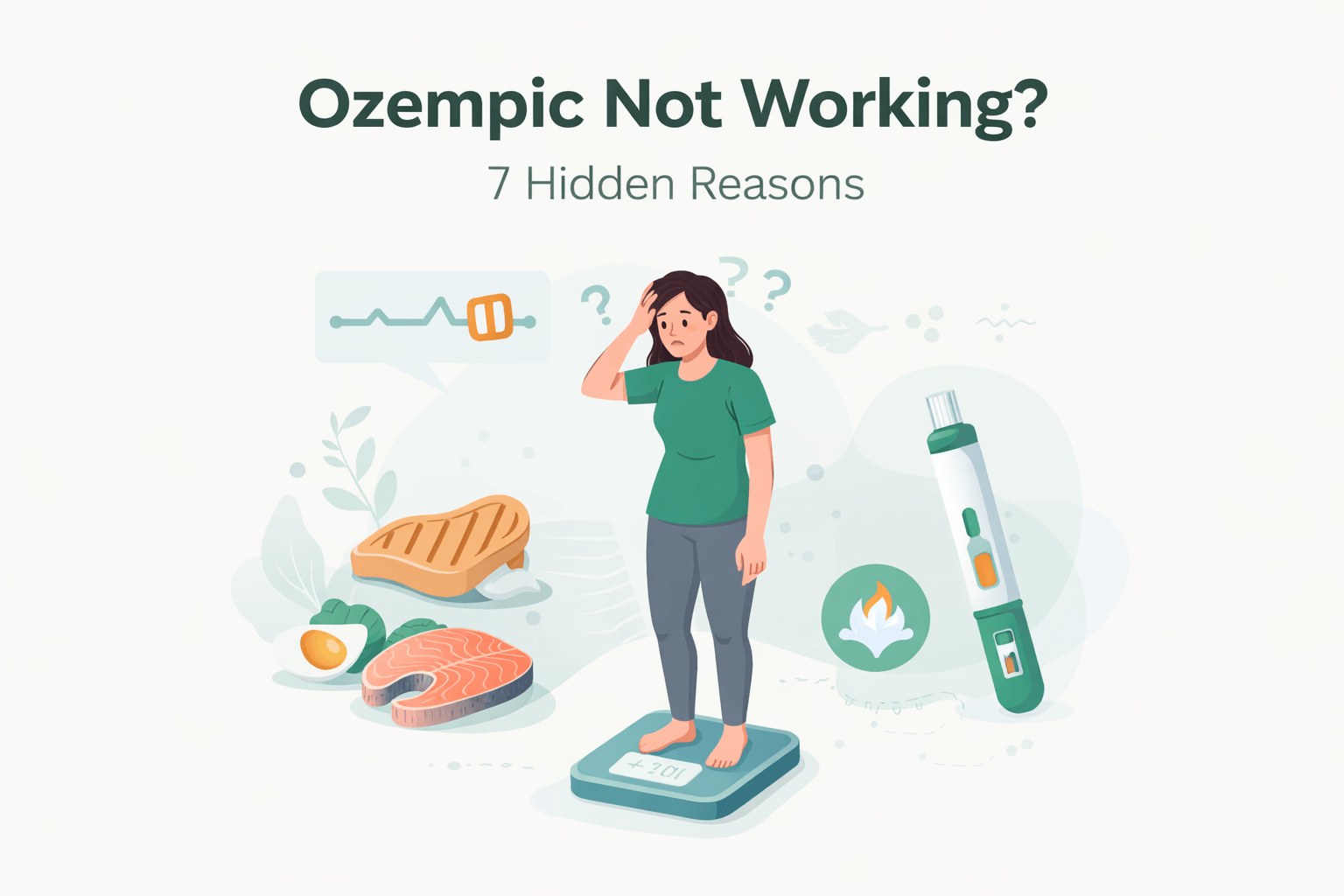
| Quick Answer: Why Am I Not Losing Weight on Ozempic? Ozempic reduces appetite, but it does not automatically create the right conditions for fat loss. If weight loss has stalled, the most common reasons are eating too little protein, losing muscle instead of fat, consuming too few calories overall, or not being in a consistent calorie deficit. Addressing these nutritional gaps — not adjusting your dose — is usually what moves things forward. |
Select each factor below. Work through the checklist and the guide will flag your most likely causes and what to fix first.
For educational purposes only. Not medical advice. Always consult a qualified healthcare provider before changing your nutrition, exercise, or medication. — FueledFramework.com
You started Ozempic expecting the weight to come off. Maybe it did, for a while. Then it slowed. Or it stopped entirely. Now you’re wondering if the medication is working at all.
You’re not alone. Research suggests that around 30–40% of GLP-1 users hit a weight loss plateau at some point during treatment. The frustration is real — but the cause is rarely the medication itself.
Ozempic (semaglutide) works primarily by reducing appetite and slowing gastric emptying. That creates an opportunity to eat less and lose weight. But opportunity is not the same as a plan. Without the right nutritional structure in place, your body will find ways to adapt — and weight loss will stall.
This article breaks down the 7 most common reasons weight loss stops on Ozempic, and explains what to do about each one. For a deeper overview of how GLP-1 medications interact with nutrition, start with the GLP-1 Nutrition Pillar.
Reason 1: You’re Not Eating Enough Protein
Protein is the single most important nutritional variable for anyone on a GLP-1 medication. When appetite drops, protein intake almost always drops with it — and that creates a chain reaction that works against fat loss.
What protein does in a calorie deficit
Protein has a high thermic effect, meaning your body burns more energy digesting it compared to carbohydrates or fat. It preserves lean muscle mass, which keeps your metabolic rate from dropping. It also creates stronger satiety signals — so even on reduced appetite, it helps prevent under-fuelling.
According to the National Institutes of Health, higher protein intake during calorie restriction helps preserve fat-free mass and supports better weight loss outcomes. This is especially relevant for GLP-1 users, who often eat significantly less overall.
How much protein you actually need
The Fueled Framework standard is 0.7–1.0 grams of protein per pound of goal body weight, spread across 3–4 meals per day. For someone with a goal weight of 160 lbs, that means 112–160 grams of protein daily.
Most GLP-1 users are falling well short of this. Use the GLP-1 Protein Calculator to find your personal protein target, or explore the Protein Intake Calculator for a broader metabolic breakdown.
| Fix It Prioritise protein at every meal — before anything else on your plate. Aim for 30–40g per meal. Eggs, chicken, Greek yogurt, cottage cheese, and fish are practical, low-volume protein sources that work well when appetite is low. |
Reason 2: You’re Losing Muscle Instead of Fat
This is one of the most underrecognised reasons for an Ozempic plateau — and one of the most damaging long-term.
When you eat very little and don’t prioritise protein, your body breaks down muscle tissue for energy alongside fat. On the scale, you may still see the number move down. But what you’re losing is not the same composition. Losing muscle means losing metabolic capacity.
Why muscle loss leads to plateaus
Muscle is metabolically expensive to maintain. The more lean mass you carry, the more calories your body burns at rest. Lose muscle, and your basal metabolic rate drops. Your body becomes more efficient at operating on fewer calories — and fat loss slows or stops entirely.
A 2021 study in Obesity Reviews found that GLP-1 receptor agonists reduce total body weight, but that a meaningful portion of that loss can come from lean mass without targeted nutritional support. This pattern accelerates plateau risk.
How to protect muscle while losing fat
- Hit your daily protein target every day — not just most days
- Include resistance training 2–3 times per week
- Avoid eating gaps longer than 4–5 hours, which can increase muscle catabolism
- Do not rely on the scale alone — track measurements and how your clothes fit
Reason 3: Your Calories Are Too Low
This one feels counterintuitive. If eating less is the goal, how can too few calories be a problem?
The answer is metabolic adaptation. When you consistently eat below a certain threshold — often cited as below 1,000–1,200 calories per day for most adults — your body treats this as a survival signal. It lowers your resting metabolic rate, reduces non-exercise activity, and becomes highly efficient at conserving energy.
The GLP-1 over-restriction trap
Ozempic can reduce appetite so dramatically that some users eat only 600–800 calories per day without realising the longer-term consequences. In the short term, weight may drop quickly. But over weeks, the body adapts — and fat loss slows sharply.
The Cleveland Clinic notes that very low-calorie diets often produce rapid early weight loss followed by significant metabolic slowdown, making sustained fat loss much harder to maintain.
What a sustainable deficit looks like
A moderate deficit of 400–600 calories below your total daily energy expenditure is typically more effective over time than aggressive restriction. It preserves metabolic rate, protects muscle, and produces steady, sustainable fat loss.
If you’re not sure where your calorie floor is, this is one of the most important things to work out with a registered dietitian or using a validated metabolic tool.
| Fix It If you’re eating under 1,000 calories daily, consider working with a healthcare provider to gradually increase your intake back to a moderate deficit. The goal is a sustainable calorie gap — not the smallest number you can survive on. |
Reason 4: You’re Not in a Consistent Calorie Deficit
The flip side of eating too little is inconsistency. Many people who feel they are eating very little are still not in a sustained calorie deficit when their full week of eating is accounted for.
Hidden calories and tracking gaps
Liquid calories, cooking oils, sauces, snacks, and weekend eating patterns all add up. A common pattern is tight restriction Monday through Thursday, followed by a significant increase in calories Friday through Sunday — which can cancel out most of the weekly deficit.
GLP-1 medications reduce hunger, but they don’t eliminate emotional eating, habit-driven eating, or social eating. These patterns can persist even when physical appetite has dropped.
Behaviour and structure matter
Consistency doesn’t require perfection. It requires a reliable enough structure that your weekly average calorie intake stays below your weekly average energy expenditure. That means having a plan for higher-risk eating situations, not just tracking the easy days.
- Log food for at least 2 weeks to identify real intake patterns
- Watch liquid calories — these are the most commonly underestimated source
- Plan for weekends and social meals rather than hoping appetite suppression is enough
- Aim for consistent meal timing to reduce unplanned eating
Reason 5: Water Retention Is Masking Fat Loss
Sometimes the scale is not telling the truth — or at least, not the whole truth. Water retention is a common and frustrating experience for GLP-1 users, and it can completely mask real fat loss for weeks at a time.
What causes fluid shifts on Ozempic
Changes in sodium intake, hormonal fluctuations, increased or decreased carbohydrate intake, inflammation, and stress can all cause the body to hold significantly more water than usual. A single day of higher sodium or carbohydrate intake can add 2–5 lbs of scale weight overnight with no actual fat gain.
Some GLP-1 users also experience changes in electrolyte balance as eating patterns shift, which can contribute to fluid retention or loss.
Why the scale is not your only data point
Body composition changes — specifically, the ratio of fat to muscle — are a much more useful measure of progress than scale weight alone. If your clothes are fitting differently, your waist measurement is decreasing, and your energy is stable, fat loss is likely happening even if the scale is not moving.
For guidance on hydration and electrolyte management on GLP-1 medications, see GLP-1 Side Effects and Nutrition Support.
| Fix It Track more than just scale weight. Measure your waist, hips, and upper arm weekly. Take progress photos monthly. These metrics reveal fat loss that the scale hides during periods of fluid retention. |
Reason 6: Your Body Has Adapted
Even with the right protein, the right calories, and consistent behaviour, weight loss plateaus are a normal and expected part of the process. The body is designed to resist change — and it will use every physiological tool it has to slow fat loss once it senses sustained energy restriction.
What metabolic adaptation actually looks like
As you lose weight, your total daily energy expenditure decreases — because a smaller body requires fewer calories to function. This is not a failure. It is physiology. But it does mean that the deficit that worked at the start of treatment may no longer be sufficient three or six months in.
Your body also downregulates non-exercise activity thermogenesis (NEAT) — the unconscious movement and fidgeting you do throughout the day. Studies have shown that NEAT can decrease by several hundred calories per day in response to calorie restriction, without any conscious awareness.
How to work through a genuine plateau
A true metabolic plateau — one that has lasted more than 3–4 weeks despite consistent nutrition and activity — typically requires one or more of the following adjustments:
- A structured diet break or refeed period at maintenance calories to restore metabolic rate
- An increase in physical activity, particularly resistance training
- A reassessment of protein intake and total calorie targets based on current body weight
- A review with your prescribing healthcare provider to evaluate whether your dose or protocol requires adjustment
Reason 7: You’re Not Supporting Your Metabolism
Ozempic is a tool. It creates the conditions for weight loss by reducing appetite and supporting blood sugar regulation. But if the wider metabolic environment is not supported, the medication cannot compensate on its own.
The four pillars of metabolic support on GLP-1
At Fueled Framework, we focus on four variables that work together to support fat loss and metabolic health during GLP-1 treatment:
- Protein: 0.7–1.0g per pound of goal body weight, distributed across meals
- Hydration: 2–3 litres of water daily to support kidney function, appetite regulation, and electrolyte balance
- Micronutrients: B vitamins, magnesium, zinc, and iron — often depleted with reduced food intake
- Muscle stimulus: Regular resistance training to maintain lean mass and keep metabolic rate elevated
When appetite suppression works against you
One of the most underappreciated challenges of GLP-1 therapy is that severe appetite suppression makes it harder — not easier — to meet nutritional needs. Many users simply do not feel hungry enough to eat what their body needs to function optimally.
This is where structured meal planning, rather than intuitive eating, becomes essential. Waiting to eat until you’re hungry on Ozempic often means not eating at all.
For practical meal structure and food selection guidance, see Best Foods to Eat on GLP-1 Medications.
The Bottom Line
If weight loss has stalled on Ozempic, the medication is almost certainly not the problem.
The most common causes are nutritional — too little protein, too few calories, inconsistent deficits, or muscle loss that quietly slows the metabolism. Address those gaps, and most plateaus break. Ignore them, and no dose adjustment will fully compensate.
The path forward is structured, not restrictive. Eat enough protein. Maintain a moderate and consistent calorie deficit. Protect your muscle. Support your hydration and micronutrient intake. Then let the medication do what it was designed to do.
For a full walkthrough of how to structure your nutrition around GLP-1 therapy, visit the GLP-1 Nutrition Pillar Page. You’ll find detailed guidance on protein targets, meal timing, food selection, side effect management, and metabolic support — all in one place.
References
1. Wilding JPH, et al. Once-weekly semaglutide in adults with overweight or obesity. New England Journal of Medicine.
2. National Institutes of Health. Dietary protein and muscle mass: translating science to application and health benefit.
3. Cleveland Clinic. How to choose healthy fats into your diet.
4. Martens EA, et al. Protein leverage and energy intake. Obesity Reviews.
5. Mayo Clinic. Ozempic (semaglutide): Weight loss, side effects, and dosing.